
CFA Curriculum · Framework · Foundation
CFA classes in Abu Dhabi: 1-on-1 coaching or a classroom course?
Muhammad Ahmed Raza · · 4 min read · For CFA Level I, CFA Level II
When to use this
You have registered for CFA Level I or Level II, or you are about to, and you live or work in Abu Dhabi. You expect to spend 300 hours or more on the curriculum[1], most of them around a full-time job or a degree. The question is where your paid hours should go.
We teach CFA 1-on-1, so read this knowing that. We have tried to say plainly when a group class or self-study is the better choice.
The three ways to prepare
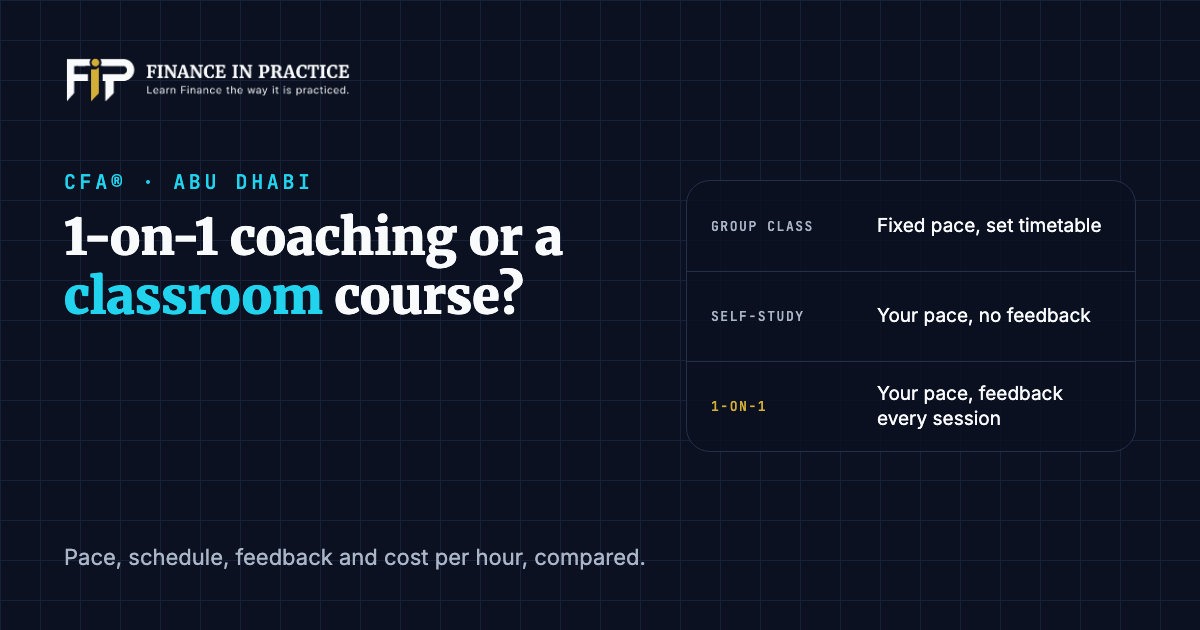
Group class. An instructor teaches the curriculum to a class in a fixed order, in a room or on a video call. You get a timetable, classmates and a teacher to ask. The pace is set for the class, not for you.
Self-study. You read the CFA Institute curriculum or a prep provider's notes and work the practice questions alone. It is the cheapest route and the most flexible, and the easiest one to fall behind on.
1-on-1 coaching. One instructor, one candidate. Sessions start from the questions you got wrong, so time goes to your weak topics and skips the ones you already know. It costs more per hour than a class seat, but you usually need fewer hours.
| Group class | Self-study | 1-on-1 coaching | |
|---|---|---|---|
| Pace | Set by the class plan | Yours | Yours and adjusted each session |
| Schedule | Fixed class times | Any time | Booked around your work |
| Feedback on your mistakes | Shared with the class | None | Every session |
| Accountability | Classmates and attendance | Only yourself | Booked sessions and tracked scores |
| Cost | One course fee | Study materials only | AED 150 an hour or AED 3000 for 30 hours |
| Suits | Candidates who want a routine | Disciplined readers | Working candidates with weak topics to fix |
How to choose
- Take a timed test first. Do 30 to 40 questions under exam timing, for example from the CFA Question Bank. Write down your score by topic.
- Count your hours honestly. Weeks to the exam multiplied by hours you can really study each week. If that is well under 300, you need help using the hours well, not more material.
- Find what is actually holding you back. If you understand the reading but run out of time, you need practice. If you can't follow the reading at all, you need teaching. If you keep putting off study, you need a timetable.
- Match each gap to a format. Practice is self-study. Teaching is a class or a tutor. A timetable is a class or booked sessions.
- Price the hours. Multiply the hours of help you need by the hourly rate, and compare that with a course fee that covers every topic, including the ones you don't need taught.
Worked example: a working analyst in Abu Dhabi
Sara (not her real name) works in a bank in Abu Dhabi and sits Level I in August 2027. That gives her about nine months at 8 to 10 hours a week, which is enough for the 300 hours.
Her first timed test: above 70% on Ethics and Quantitative Methods, under 50% on Financial Statement Analysis and Fixed Income. A group class would take her through all ten topics at the same pace. Instead she:
- reads the curriculum on her own for the topics she already scores well on;
- books 10 hours of 1-on-1 coaching on FSA and Fixed Income: 10 × AED 150 = AED 1,500;
- takes one month of coaching before the exam for mock reviews: 30 hours for AED 3,000, which works out at AED 100 an hour.
Her total coaching cost is AED 4,500 for 40 hours, all of it on topics where she was losing marks. If her first test had been under 50% on most topics, a full group course or monthly coaching from the start would have made more sense.
Limitations
This framework assumes you can judge your own practice results honestly. Many candidates can't at first, which is what a diagnostic is for. It also says nothing about the quality of a particular class or tutor: a good group teacher beats a weak 1-on-1 one. Ask for a trial session or a diagnostic before paying for any of them, including ours.
Frequently asked questions
Where can I take 1-on-1 CFA classes in Abu Dhabi?
We teach CFA Level I and Level II 1-on-1, in person at your home in Abu Dhabi or live online anywhere in the UAE. Every course starts with a free 30-minute diagnostic.
How much does 1-on-1 CFA coaching cost?
AED 150 an hour, or AED 3,000 a month for 30 hours, which is AED 100 an hour. CFA Institute exam and registration fees are separate and paid to CFA Institute.
Do I still need the CFA Institute curriculum?
Yes. The exam is set on it, and coaching works from its practice questions.
Is 1-on-1 better than a group class?
Not for everyone. A group class suits candidates who want a fixed routine and classmates. 1-on-1 suits candidates whose time is short and who know, or want to find out, exactly where they lose marks.
Sources
- [1]CFA Program: Level I and Level II exams. CFA Institute. Accessed 2026-11-07.